Luna Casino Verification and KYC for UK Players
 Available in GB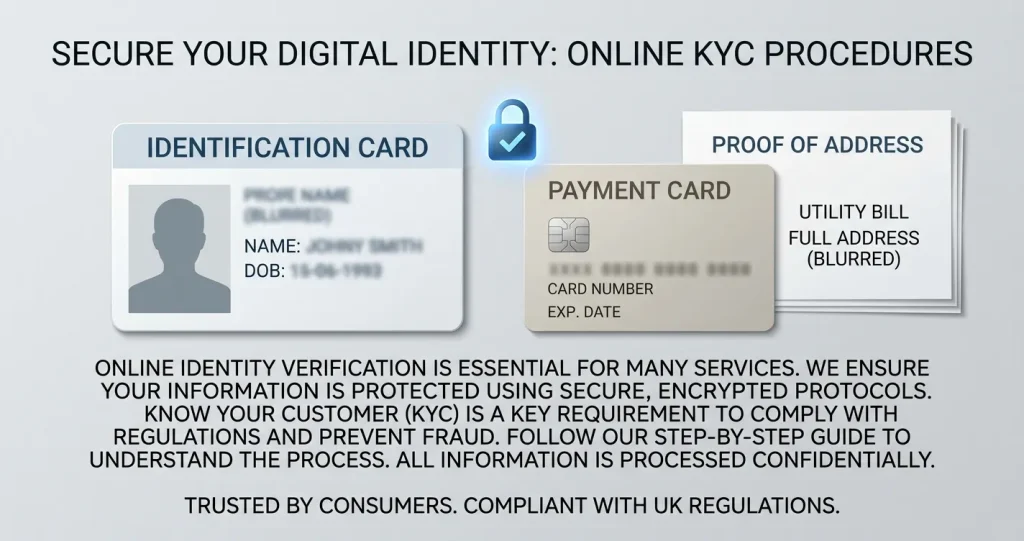
Luna Casino KYC guide
Luna Casino can require UK customers to verify identity, registered address and ownership of the payment method used. Its current terms also connect verification to withdrawals and to wider anti-money-laundering and responsible-gambling checks. Examples on Luna’s verification guidance include a driving licence, passport or government-issued ID for identity, a utility bill or bank statement for address, and evidence relating to a bank card or other payment method where relevant.
Those examples should not be treated as an exhaustive list for every account. What matters is the purpose of the request and whether the document clearly proves the information Luna needs. There is also no need to assume a guaranteed verification time: Luna publishes indicative timing on its document page, but extra checks can extend the process, so this guide does not promise a fixed completion window.
Table of Contents
- What Luna may ask you to verify
- Why identity verification happens
- Proof of ID: what makes a useful document?
- Proof of address: why freshness matters
- Payment-method ownership checks
- How KYC can affect a withdrawal
- KYC is different from a financial-vulnerability check
- Source-of-funds questions are a separate layer
- How to prepare documents without oversharing
- What not to assume about verification time
- Keep identity, payment ownership and financial checks separate
- What Luna can verify before money leaves your account
- Recommend
What Luna may ask you to verify
Luna’s current terms say customers may need to provide proof of ID, registered address and ownership of certain deposit methods. Its separate uploading-documents page gives concrete examples of the types of evidence it accepts for those categories.
| Verification purpose | Examples Luna currently lists | What the evidence is meant to show |
|---|---|---|
| Identity | Driving licence, passport, government-issued ID card | That the account belongs to the named individual |
| Address | Utility bill or bank statement | That the registered address belongs to the customer |
| Payment ownership | Bank-card or payment-method evidence where required | That the customer is authorised to use the funding method |
The operator may request additional evidence depending on the account and the reason for the review. That is why a short examples table is more accurate than claiming one universal document list for every player.
Why identity verification happens
KYC is not simply a cashier formality. The Gambling Commission says effective identity verification supports several regulatory objectives, including preventing underage gambling, identifying self-excluded customers, supporting anti-money-laundering controls, reducing fraud risk and limiting avoidable customer disputes.
For remote operators, the minimum expectation is that the customer’s name, address and date of birth can be linked to the same individual before that person is allowed to gamble. In practice, some checks may be completed electronically, while other cases require uploaded evidence.
This is also why accurate information at Luna Casino registration matters. A verification process becomes harder when account details do not match the customer’s real identity or current address.
Proof of ID: what makes a useful document?
Luna’s current verification page lists a driving licence, passport and government-issued ID card as acceptable identity-document examples. It also describes quality expectations such as a clear image, valid document and visible identifying details.
The practical lesson is to submit a document that can actually be read and checked. A blurred image, cropped edge or expired document can fail to establish the information the operator needs, even when the document type itself would normally be acceptable.
Only use the operator’s approved upload route. Luna’s terms state that verification documents should be sent through the Upload Docs area in the account or personal area rather than through unrelated channels.
Proof of address: why freshness matters
For address checks, Luna’s current document guidance lists a utility bill or bank statement. It also says the evidence should be issued in the customer’s name and display the address. The purpose is to connect the registered account address with a real, current record.
If you have recently moved, update the account before assuming an older document will be sufficient. A mismatch between the profile and the evidence can create an avoidable follow-up request.
Do not send more information than the operator asks for. Verification should establish the relevant fact without unnecessarily distributing personal data through unofficial channels.
Payment-method ownership checks
Luna can also ask for evidence that a payment method belongs to, or is authorised for use by, the account holder. Its document guidance specifically discusses bank-card verification and its terms describe further requirements when a payment method belongs to someone else.
This is one reason to use payment methods in your own name wherever possible. Third-party payment use can lead to extra documentation and can complicate an otherwise straightforward review.
Payment options themselves are covered in our Luna Casino payment methods guide. KYC focuses on who owns or controls the method, not on comparing the merits of each deposit route.
How KYC can affect a withdrawal
Luna’s terms state that withdrawals are processed only after required account evidence has been supplied and approved. Depending on the method and circumstances, that can include proof of address, proof of identity, proof of payment-method ownership and evidence relating to the source of funds used for gambling.
The Gambling Commission has also stressed that operators should request identity information as early as practicable rather than waiting until a customer asks to withdraw, if the information could reasonably have been collected earlier. That principle is important because it separates legitimate verification from avoidable last-minute friction.
For cashout mechanics, use our Luna Casino withdrawal guide. This page is concerned with the evidence that can sit behind a withdrawal review, not the withdrawal method itself.
KYC is different from a financial-vulnerability check
Identity verification and financial-vulnerability checks can appear in the same account journey, but they answer different questions. KYC asks who the customer is and whether relevant account or payment information can be verified. Financial-vulnerability checks are customer-protection measures that use financial-risk information to identify signs that a customer may be in difficulty.
The UKGC says current light-touch financial-vulnerability checks use publicly available information. It has also decided to introduce Financial Risk Assessments in stages for higher-spending customers, with the July 2026 material explaining the staged approach rather than giving a universal immediate check for every account.
Keeping these concepts separate helps avoid a common mistake: treating every request for financial information as basic ID verification, or assuming that an ID document automatically resolves a separate affordability or source-of-funds concern.
Source-of-funds questions are a separate layer
Luna’s terms allow account checks to extend beyond basic identity where anti-money-laundering or responsible-gambling obligations require further review. The terms refer to areas such as financial standing, source of funds and gaming activity.
That does not mean every customer will receive the same request. A source-of-funds review is context dependent and should not be presented as a standard registration document for every player.
If Luna asks for this type of evidence, focus on the exact request in the account message or official communication rather than relying on a generic checklist from a review site.
How to prepare documents without oversharing
- Use the official upload area. Do not send identity files to unofficial contacts.
- Follow the requested image quality. Make sure the relevant information is readable and the document is complete.
- Protect details the operator explicitly allows you to mask. For bank-card images, follow Luna’s current masking instructions rather than exposing a full card number.
- Match the account data. A document should support the name and address recorded on the account.
- Respond to the actual request. Avoid uploading unrelated personal documents merely because they appear on a generic KYC list elsewhere.
What not to assume about verification time
Luna’s document page gives an indicative review time and notes that extra verification can take longer. Because timing depends on the case, the document quality and whether additional checks are needed, it is safer not to treat any published estimate as a guaranteed deadline.
If a verification remains unresolved, use Luna’s official support route and keep the account messages relating to the request. Avoid opening duplicate accounts or repeatedly resubmitting different files unless the operator tells you the first submission was unsuitable.
The most useful expectation is therefore process based rather than time based: submit the requested evidence clearly, through the correct channel, and be prepared for follow-up where the account requires a deeper review.
Keep identity, payment ownership and financial checks separate
Several kinds of account checks can happen around the same time, but they do not all answer the same question. Identity evidence is used to establish who holds the account and can include examples such as a passport or driving licence. Address evidence supports the registered residential details, while payment-method evidence is about whether the funding method belongs to the account holder. Luna can request a combination of these depending on the case, so a document that satisfies one purpose does not automatically satisfy the others.
Financial-vulnerability or source-of-funds questions should also be understood separately from basic identity verification. They are part of the wider UK customer-protection and anti-money-laundering framework and can involve different information. Keeping those categories distinct makes it easier to respond to the request actually shown in the account instead of sending an unnecessarily broad bundle of personal documents.
For the same reason, do not infer a fixed completion time from another player’s experience. The useful preparation is accurate account data, readable evidence, ownership of the payment methods you use and attention to any follow-up message from the operator.
What Luna can verify before money leaves your account
Before a withdrawal is released, Luna can verify more than a single ID image. Depending on the account, the process may cover identity, registered address, ownership of the payment method and further evidence connected with source of funds or account-risk review. Those categories come from Luna’s current terms and verification material, but the exact combination can vary.
The cleanest customer journey starts earlier: register with accurate details, use your own payment methods and answer legitimate verification requests when they arise. For the wider operator and licensing context behind those controls, see our Luna Casino UKGC licence guide, and return to the Luna Casino review for the full UK overview.
Recommend

Luna Casino Games: Slots, Tables and Live Casino
Luna Casino game library Luna Casino gives UK players access to a broad mix of...
Luna Casino Licence, Operator and Trust Signals in the UK
Luna Casino UK trust check Luna Casino's Great Britain regulatory link can be checked directly...

Luna Casino Bonus and Promotions for UK Players
Luna Casino UK bonuses Luna Casino's current UK welcome promotion is a 100% deposit match...
Luna Casino Payment Methods in the UK
Luna Casino payment methods Luna Casino supports a mix of card, e-wallet and bank-style payment...
Luna Casino Mobile: App and Browser Experience
Luna Casino mobile guide Luna Casino works on phones and tablets through a mobile-optimised browser...
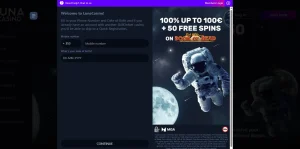
Luna Casino Registration and Account Setup
Luna Casino account guide For a UK player, Luna Casino registration is best understood as...